
How to Create a Paid Service or Space
Feature Overview
The Payments feature allows your organisation to collect money from residents directly through the platform. Once a Stripe account is connected, you can charge services and spaces (such as private dining rooms, BBQs, gyms or any service or space you list in the app).
Payments are processed securely by Stripe, and the funds are paid out to your nominated bank account. You can connect a single Stripe account at the organisation level or connect multiple Stripe accounts and choose which one each event or bookable should pay into — useful for communities that need to keep funds separate (for example, when a clubhouse and a café are run by different operators).
Residents pay using a credit or debit card directly in the app. Where appropriate, you can also accept cash and mark the payment as received yourself.
TOP TIP: To learn how to connect a Stripe Account, click here Setting Up & Managing Payments
Creating a Paid Service or Space
Services or spaces that residents can reserve in the app — for example, the dining room, the BBQ, a tennis court, or a personal training session can be made payable.
To turn on payments for a service or space, go to Services & Spaces in the left-hand menu and either create a new service or space or open an existing one.
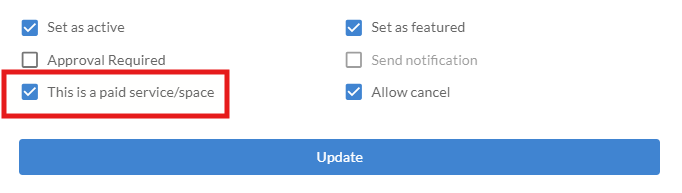
Tick the This is a paid service/space checkbox. The fee fields will then appear:
A service or space can only be marked as paid for if its booking option is set to Booking Request or Booking Calendar.
Booking Request: Payment is charged as a one-off fee per booking.
Booking Calendar: You can choose to charge either per time slot or as a one-off fee per booking.
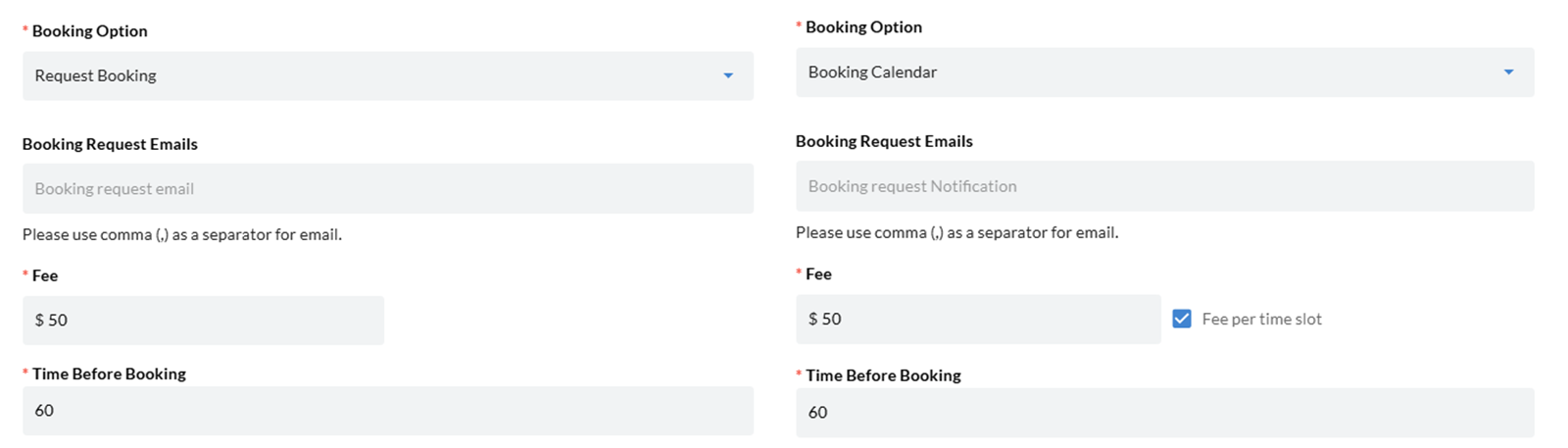
- Fee — the amount you want to charge, in your organisation's currency. Enter 0.01 or higher.
- Fee per time slot — this checkbox controls how the fee is applied - only available on booking calendar.
- If unticked, the resident pays the fee once for the booking, no matter how long they reserve. For example, a $20 BBQ booking is $20 whether they book one slot or four consecutive slots.
- If ticked, the resident pays the fee for each time slot they reserve. For example, $10 per 30-minute slot × 4 slots = $40.
- Time Before Booking - This is the time before the booking that the payment will be taken.
- Payment Methods — same as for events: card, cash, or both.
- Payout Method — choose which Stripe account this payment is to go to. Leave this as default to use your organisation's default account.
TOP TIP: Use a one-off fee for things like a flat booking deposit (e.g. $50 to reserve the dining room for the night). Use Fee per time slot when the cost should scale with how long the resident is using the space — for example, $5 per 30 minutes for a tennis court.
Save the bookable and your residents will see the price in the app when they go to book it.
What Residents See
For paid services or spaces (like a private dining room or a tennis court), a resident finds the service or space in the app and taps to start a booking. They:
- Pick the date and the time slot(s) they want to book. For per-time-slot services or spaces, the running total updates as they add more slots.
- See the fee clearly displayed before they commit — either a single one-off amount or the per-slot amount × the number of slots they've selected.
- Choose a payment method (card or cash, depending on what you enabled).
- For card, they enter their card details or use a saved card and confirm.
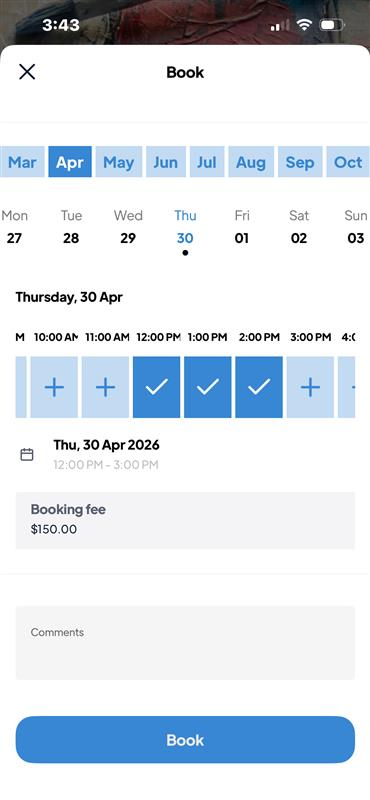
Once payment succeeds, the booking is confirmed immediately and they receive a confirmation in the app. They can see and manage their booking from the My Bookings section.
If they chose Cash, the booking is held with a status of Unpaid until you mark it as paid from the booking details screen in the admin portal.
Viewing Balances & Paying Out
You can see how much money is sitting in your Stripe account at any time from Settings > Organisation > Payment.
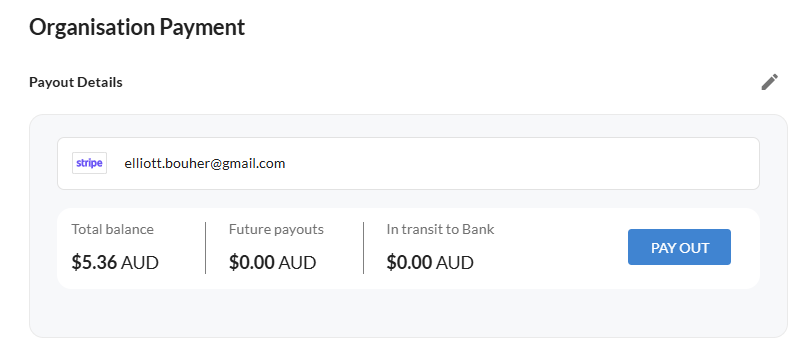
The Payout Details panel shows three figures:
- Total Balance — money that has cleared and is ready to be sent to your bank.
- Future Payouts — money from recent payments that is still being held by Stripe (typically a couple of days while the card transactions clear).
- In Transit to Bank — money that has already been sent to your bank account but hasn't landed yet.
If you want to send your available balance to your bank straight away, click the PAY OUT button. Otherwise, Stripe will pay you out automatically on the schedule you set up during onboarding (most commonly weekly or daily).
If you have multiple Stripe accounts connected, use the pencil at the top of the panel to switch between them — balances are tracked separately for each account.
Refunds & Transactions
Sometimes you need to give a resident their money back — for example, they no longer want to use the service or space.
To refund a payment:
- Open the service or space that the payment relates to.
- Go to the Booking tab and select the resident that the booking relates to - usually found in the accepted tab as the booking will have been accepted. Scroll to the bottom and on the left, there will be Payment information.
- Click the Refund button.
- Confirm the refund. The amount is returned to the resident's original card. The transaction status updates to Refund Requested and then to Refunded once Stripe completes the refund (this is usually instant but can take a few business days to appear on the resident's statement).
TIP: Only payments with the status Successful can be refunded. If a payment is still pending or has already been refunded, the Refund button will be greyed out. Cash payments don't go through Stripe, so refund those by paying the resident back directly and updating the transaction status manually.
Each transaction record stores the amount paid, the processing fee, the platform fee, who paid, and which Stripe account the money went into. This is useful at end of month for reconciling against your Stripe dashboard.